
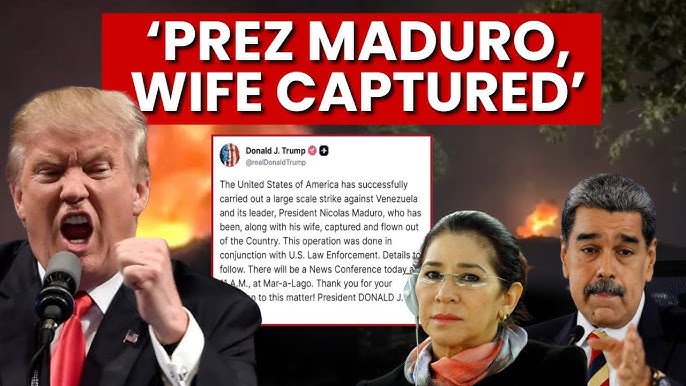
Kathmandu — In Latin American politics, the anti-U.S. current is not always weak or fleeting. At times, this very current defines a country’s power structure, policies, and identity. Venezuelan President Nicolás Maduro is a leader who emerged from such a political current, whose entire political life has been intertwined with resistance to U.S. dominance, intervention, and pressure.
Nicolás Maduro Moros was born on November 23, 1962, in Caracas. Raised in a middle-class family, he was shaped more by working-class life and activism than by formal higher education. While working as a driver in the Caracas Metro, he became active in the trade union movement. This labor background appears to have given him a deep political awareness of social inequality, foreign domination, and the role of the state.
In the 1990s, as Hugo Chávez rose to prominence, Maduro came close to him. Chávez’s anti-American, anti-imperialist, and socialist ideology strengthened Maduro politically. It was during this period that he became a follower of the “Bolivarian Revolution.”
Chávez and the Challenge to U.S. Dominance
Hugo Chávez was a leader who sought to break U.S. influence in Venezuela. His policies—reducing U.S. control over strategic resources like oil, expanding social programs, and strengthening relations with countries such as Cuba, Russia, and China—angered Washington. This political legacy was inherited by Maduro.
During Chávez’s rule, Maduro became foreign minister. In that role, he openly criticized U.S. foreign policy and spoke out in defense of Venezuela’s sovereignty. This clearly positioned him as a leader within the anti-U.S. camp.
Presidency and Growing Confrontation
After Chávez’s death in 2013, Maduro became president. From that moment, tensions between the United States and Venezuela intensified. The U.S. administration labeled the Maduro government “undemocratic” and began imposing economic sanctions. Restrictions on oil trade, the banking system, and international transactions pushed Venezuela’s economy into a deep crisis.
The Maduro government, however, described this as an “economic war.” According to Maduro, Venezuela’s crisis was the result of U.S. intervention more than internal failures. This narrative helped mobilize and consolidate his supporters.
Maduro is a leader who carries a socialist discourse. A strong role for the state, social welfare programs, and government control over natural resources form the basis of his politics.
The United States and its allies have criticized him as an authoritarian leader. For Maduro’s supporters, however, these criticisms are merely pretexts to justify U.S. interference.
Accusations of a U.S. “Takeover” Attempt
In 2019, Venezuela’s political crisis reached its peak when opposition leader Juan Guaidó was declared “interim president” by the United States and several Western countries. The Maduro government openly described this as a coup attempt and a plan to seize power.
Since then, accusations of coup plots, plans to oust Maduro using mercenaries, and U.S. control over oil companies and foreign assets have repeatedly surfaced.
For Maduro, the United States is not merely a critical power, but a force seeking to seize control over the country’s sovereignty. This narrative has helped him not only remain in power but also define his political existence.
Maduro is not just a president; he has become a symbol of anti-U.S. political resistance. For his supporters, he is a leader who stands up against foreign domination.

Add Comment