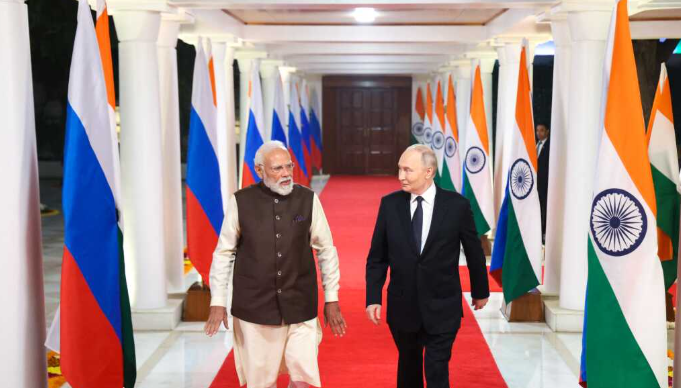
kathmandu/ekalopati : The high‑level meeting between Russian President Vladimir Putin and Indian Prime Minister Narendra Modi in New Delhi is being viewed as a turning point in regional politics and economics. Both leaders announced an Economic Cooperation Programme until 2030, prioritizing energy, trade, labor mobility, and cultural exchange.
Modi personally welcomed Putin at the airport, a gesture of warmth and respect. During their talks, Russia pledged to provide “uninterrupted” supplies of crude oil and fuel to India. This commitment not only strengthens India’s energy security but also carries the potential to stabilize Asian markets. India has increased imports of Russian oil in recent years, and this assurance signals India’s determination to remain independent despite Western pressure.
The two countries finalized the Economic Cooperation Programme till 2030, which emphasizes trade diversification, healthcare, maritime transport, and small nuclear reactor technology. Agreements were also signed to make it easier for Indian workers to find employment in Russia. Cooperation in healthcare and people‑to‑people exchanges was highlighted as well.
As a symbolic step, Russia’s state‑run media outlet Russia Today (RT) launched its broadcast in India, expanding Russia’s informational reach across Asia.
The impact of this meeting could also be felt in Nepal. Nepal and Russia share a long history of relations. Since the Cold War era, Russia has supported Nepal in education, healthcare, and infrastructure. The new India–Russia cooperation may indirectly benefit Nepal through regional projects. Stable energy supplies to India could benefit Nepal via cross‑border trade, expanded labor mobility may open opportunities for Nepali workers, and collaboration in healthcare and cultural exchange could also extend to Nepal.
Despite Western pressure, India’s warm embrace of Putin — from the airport greeting to the ceremonial welcome at Rashtrapati Bhavan — clearly demonstrated its independent foreign policy. This independence could serve as an inspiration for other Asian nations.